
One Partner. Every Physics Discipline.
Managing multiple simulation suppliers is costly and inefficient. KF Engineering Solutions provides end-to-end CAE coverage — meaning your entire virtual validation programme is coordinated by a single, accountable engineering partner who understands your product, your processes, and your objectives.

Finite Element Analysis
Structural integrity validated before a single part is manufactured.
Finite Element Analysis is the cornerstone of virtual product validation. We apply linear and nonlinear FEA to assess structural performance under static, dynamic, and impact loading conditions — giving your engineering team the data needed to make confident design decisions.
Primary Tools
Capabilities
- Linear static and dynamic structural analysis
- Nonlinear analysis — large deformation, plasticity, contact
- Buckling and post-buckling analysis
- Impact and crash simulation (LS-DYNA)
- Bolted joint and fastener analysis
- Composite and laminate structural analysis
- Weld and adhesive joint assessment
What You Get
- Design validation reports to regulatory standards
- Failure mode identification and design recommendations
- Weight reduction through simulation-led optimisation
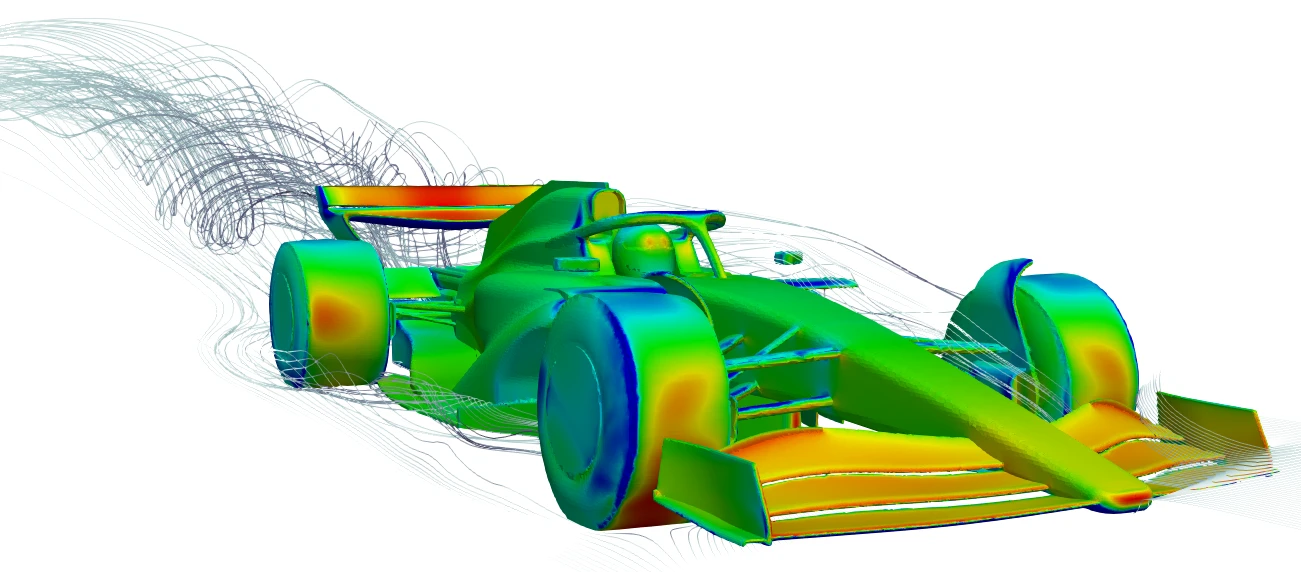
Computational Fluid Dynamics
Understand and optimise fluid and thermal behaviour before physical testing.
CFD simulation reveals how fluids, gases, and heat interact with your product — information that is impossible or prohibitively expensive to obtain through physical testing alone. We model internal and external flows, heat transfer, and aerodynamic performance across a wide range of applications.
Primary Tools
Capabilities
- Internal and external flow analysis
- Conjugate heat transfer and thermal management
- Turbulence modelling (k-ε, k-ω SST, LES)
- Aerodynamic drag and lift analysis
- HVAC and ventilation system simulation
- Rotating machinery and turbomachinery CFD
- Multiphase flow and free-surface analysis
What You Get
- Thermal hotspot identification and resolution
- Aerodynamic performance optimisation
- Cooling system design and validation

Multiphysics Simulation
Capture complex real-world interactions that single-physics models miss.
Real engineering systems rarely behave according to a single physics domain. Multiphysics simulation couples structural, thermal, and fluid analyses to capture the true behaviour of your product under operating conditions — delivering results that single-discipline models simply cannot provide.
Primary Tools
Capabilities
- Fluid-Structure Interaction (FSI)
- Thermal-structural coupling
- Electromagnetic-thermal coupling
- Acoustic-structural coupling
- Thermo-mechanical fatigue
What You Get
- Accurate representation of coupled physical behaviour
- Identification of failure modes invisible to single-physics models
- Reduced physical testing through higher-fidelity virtual models

Discrete Element Method
Simulate granular flow, particle dynamics, and bulk material handling.
DEM simulation models the behaviour of discrete particles — granular materials, powders, aggregates, and bulk solids — enabling the design and optimisation of handling, processing, and conveying equipment without costly physical trials.
Primary Tools
Capabilities
- Granular flow and bulk material handling
- Conveyor and chute design optimisation
- Particle segregation and mixing analysis
- Wear prediction on handling equipment
- DEM-CFD coupling for particle-laden flows
What You Get
- Reduced equipment wear and maintenance costs
- Optimised throughput and flow efficiency
- Elimination of blockage and segregation issues

Multi-Body Dynamics
Analyse the kinematic and dynamic behaviour of mechanical assemblies.
Multi-Body Dynamics simulation analyses the motion, forces, and loads within mechanical systems — from simple linkages to complex drivetrain assemblies. MBD provides the load inputs needed for downstream FEA and fatigue analysis.
Primary Tools
Capabilities
- Rigid and flexible body dynamics
- Kinematic and dynamic analysis of mechanisms
- Drivetrain and powertrain dynamics
- Suspension and steering system analysis
- Load extraction for FEA boundary conditions
What You Get
- Accurate load inputs for structural analysis
- Mechanism optimisation for performance and durability
- Identification of dynamic instabilities and resonances

Thermal Analysis
Ensure your product operates safely within its thermal envelope.
Thermal analysis predicts temperature distributions, heat flows, and thermal stresses within your product — critical for electronics cooling, power systems, and any application where thermal performance affects reliability or safety.
Primary Tools
Capabilities
- Steady-state and transient thermal analysis
- PCB and electronics thermal management
- Heat sink and cooling system design
- Thermal stress and fatigue analysis
- Fire and extreme temperature exposure analysis
What You Get
- Thermal hotspot elimination
- Cooling system optimisation
- Thermal fatigue life prediction

Fatigue & Durability
Predict service life and prevent in-service failures.
Fatigue failure is the leading cause of structural failures in service. Our fatigue and durability analysis predicts the service life of components under cyclic loading — enabling design changes before manufacture and preventing costly in-service failures.
Primary Tools
Capabilities
- S-N (stress-life) fatigue analysis
- E-N (strain-life) fatigue analysis
- Weld fatigue assessment (IIW, BS7608)
- Damage accumulation and Miner's rule
- Random vibration fatigue
- Multiaxial fatigue analysis
What You Get
- Service life prediction to regulatory standards
- Identification of fatigue-critical locations
- Design modifications to extend component life

NVH Analysis
Eliminate noise, vibration, and harshness issues before physical prototyping.
Noise, vibration, and harshness characteristics are critical to product quality and customer perception — particularly in automotive and industrial applications. Our NVH analysis identifies resonances, vibration modes, and acoustic issues early in the design process.
Primary Tools
Capabilities
- Modal analysis — natural frequencies and mode shapes
- Harmonic response analysis
- Random vibration and PSD analysis
- Acoustic and vibro-acoustic simulation
- Structural modification for NVH improvement
What You Get
- Resonance identification and avoidance
- Vibration isolation and damping optimisation
- Acoustic performance improvement

Design Optimisation
Maximise performance and minimise weight through simulation-driven design.
Design optimisation uses simulation to systematically explore the design space and identify configurations that best meet your performance, weight, and cost objectives. We apply topology, shape, and parametric optimisation to deliver designs that outperform those developed through traditional methods.
Primary Tools
Capabilities
- Topology optimisation for lightweighting
- Shape and size optimisation
- Parametric design of experiments (DoE)
- Multi-objective optimisation
- Additive manufacturing design optimisation
What You Get
- Weight reduction without performance compromise
- Material cost savings
- Designs optimised for additive or conventional manufacture
Discuss Your Simulation Requirements
Tell us about your project. We'll assess your simulation needs and propose a clear, cost-effective approach.